

Gale Finance Launches Tail-Risk Analytics to Help Investors Stress-Test ‘Bitcoin vs. Gold’ With Real Data
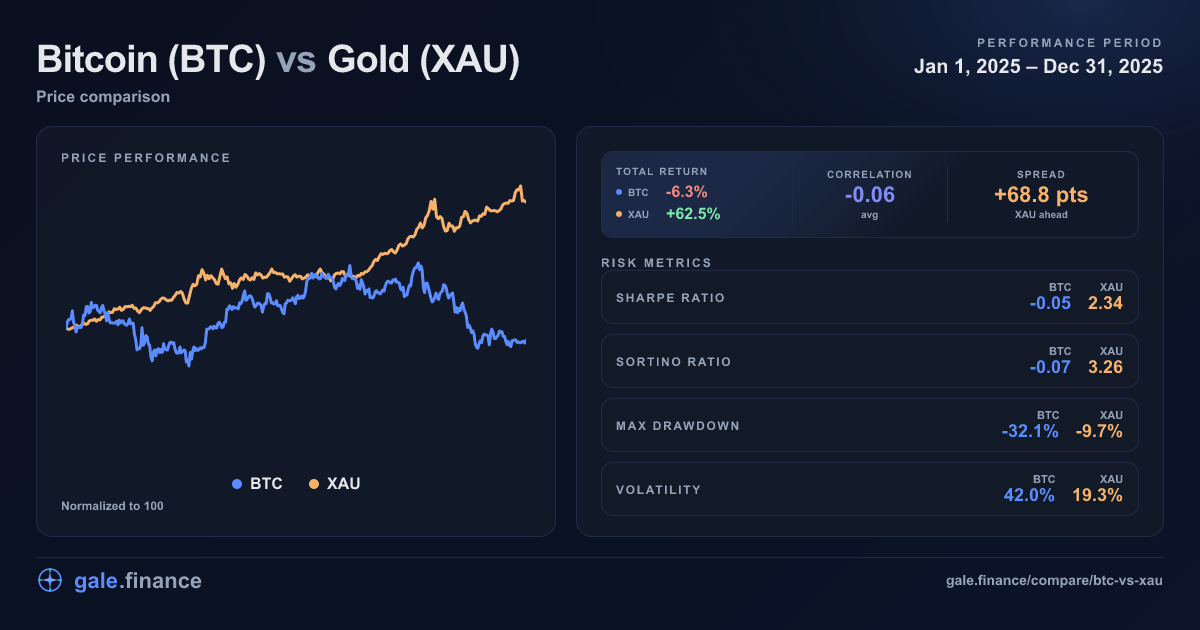
Bitcoin (BTC) vs. Gold (XAU) performance and risk in 2025
New research-driven pages show VaR, Expected Shortfall, skew, kurtosis, and downside co-moves, moving the conversation beyond “digital gold” narratives.
If you model Bitcoin like it is just a high-volatility stock, you can underestimate tail risk and over-trust tools built for normal markets.”
NEW YORK, NY, UNITED STATES, January 8, 2026 /EINPresswire.com/ -- Gale Finance today announced the expansion of its cross-asset comparison platform with a new tail-risk and distribution analysis layer designed to answer a question many investors quietly care about: "How bad do things get when they get bad?”— Sid Kalla
Gale Finance is a research and analytics platform that helps investors with data-driven deep dives and compares crypto and traditional assets like Bitcoin vs. Gold and Bitcoin vs. S&P 500. While the headlines are enticing (“Bitcoin is digital gold”), Gale Finance is built to show the actual numbers behind risk and behavior: returns, volatility, drawdowns, correlations, and now a deeper look at the distribution of daily returns.
The new tail-risk section is designed for real investor questions that don’t fit neatly into a single “average return” chart:
- How fat are the tails? (Do extreme days happen more often than a normal distribution would imply?)
- Are the extreme moves mostly to the downside or the upside?
- Do big down days in one asset tend to coincide with big down days in another?
These questions are becoming increasingly important to both retail and professional investors, as Bitcoin and crypto enter more mainstream portfolios. Several assumptions behind traditional risk metrics break down once returns deviate from a normal distribution, and Bitcoin returns have shown significant deviations from a normal distribution in the past.
To make these questions concrete, Gale Finance highlights risk measures that professional investors often use when “average volatility” isn’t the whole story:
- Value at Risk (VaR) and Expected Shortfall (CVaR) at the 5% level, based on daily log returns. This helps professional investors answer how bad things can get. VaR is the cutoff for what counts as a bad day, and CVaR measures the average move on the worst 5% of days.
- Skew and excess kurtosis to summarize asymmetry and tail thickness versus a normal baseline. Assets like Bitcoin can deviate significantly from a normal distribution assumption, especially during strong bull or bear market regimes, and traditional equity metrics provide a less informative view of the asset class.
- Downside co-moves using a 2σ tail threshold (computed on shared-date log returns) to show conditional “crash together” behavior. Bitcoin can correlate with other assets during certain monetary and investment regimes but this correlation is not uniform. Investors want to know if Bitcoin provides adequate portfolio protection, not just on average but also on days when markets get ugly.
“Investors get tripped up when they assume Bitcoin returns behave like a bell curve,” said Sid Kalla, CFA, Editor-in-Chief of Gale Finance. “If you model Bitcoin like it is just a high-volatility stock, you can underestimate tail risk and over-trust tools built for normal markets. Our goal is to show the shape of the distribution—not just the headline return—so people can make better decisions about sizing and portfolio diversification.”
Kalla added, “This isn’t about predicting the next crash. It’s about making risk visible. If two assets look uncorrelated on average but drop together on their worst days, that’s the kind of detail a serious investor wants to know.”
Why this matters (in plain English):
Normal distributions are convenient, but financial returns often have fat tails and volatility clustering. When returns aren’t normal, common shortcuts can mislead investors into making poor risk-management decisions. Bitcoin can get especially volatile in some market periods, and thus average yearly volatility can hide the true chaos by blending with calmer periods. Traditional metrics like Sharpe ratio can oversimplify risk measurements for Bitcoin because it doesn't capture the worst days or how bad those days get.
Gale Finance’s mission is to help investors look past narratives and into measurable risk—especially when comparing assets across different market structures.
Explore the Bitcoin vs. Gold tail-risk case study: https://www.gale.finance/compare/btc-vs-xau/
Sid Kalla
Gale Finance
email us here
Visit us on social media:
LinkedIn
Legal Disclaimer:
EIN Presswire provides this news content "as is" without warranty of any kind. We do not accept any responsibility or liability for the accuracy, content, images, videos, licenses, completeness, legality, or reliability of the information contained in this article. If you have any complaints or copyright issues related to this article, kindly contact the author above.
