

Gigamon 2026 Survey: 98 Percent of Breached Financial Services Organizations Report Material Impact as AI-Driven Threats Escalate
New research reveals financial services organizations are accelerating AI adoption as visibility gaps, quantum computing concerns, and cyber risks expose new vulnerabilities
Key facts:
- 77 percent experienced a breach involving AI
- 54 percent report an increase in AI-powered social engineering attacks
-
88 percent cite “harvest now, decrypt later” attacks as a major concern
SANTA CLARA, Calif., July 08, 2026 (GLOBE NEWSWIRE) -- Gigamon, a leader in deep observability, today released new research from the Gigamon 2026 Hybrid Cloud Security Survey revealing that financial services organizations are adopting AI-powered security automation significantly faster than their peers, even as AI-driven threats, encrypted traffic, and visibility challenges continue to intensify. Nearly two-thirds (66 percent) of financial services organizations report AI is already initiating security functions without human intervention, compared to just 53 percent across industries overall.
The findings published in the new report Financial Services Industry Insights: The Visibility Imperative in the Age of AI, reveal a growing challenge for security leaders: balancing rapid AI adoption with increasingly complex cyber risks, while maintaining compliance, operational resilience, and customer trust. Among organizations that experienced a breach, 98 percent reported material business impact, which included financial losses, increased cyber insurance premiums, data loss, and/or regulatory consequences.
While AI is helping financial institutions improve efficiency and automate operations, it is also becoming deeply embedded in security workflows, creating new opportunities and forms of risk. More than nine in 10 (91 percent) financial services organizations report implementing AI-powered tools to strengthen data security, and 66 percent have already enabled AI-driven automation to initiate security actions without human interaction.
Despite these investments, AI-related incidents remain widespread. The research found that 77 percent of financial services organizations experienced a breach involving AI, while 54 percent reported an increase in AI-powered social engineering attacks such as phishing and smishing. Additionally, 47 percent reported an increase in attacks targeting AI and large language model (LLM) deployments.
“AI is forcing financial institutions to accelerate innovation and risk management at the same time,” said Malcolm Kelly, managing director, CISO and head of Technology Risk, EMEA at SMBC Group. “The opportunity is significant, but so is the complexity. Financial institutions need visibility into how data, applications, and AI systems interact across hybrid cloud environments so they can identify exposure early and respond with confidence.”
Visibility Emerges as a Critical Security Requirement
Financial services organizations are investing heavily in cybersecurity, yet many still struggle to gain the visibility needed to understand and manage risk across increasingly distributed hybrid cloud environments. According to the research, 94 percent of financial services organizations have invested in new security technologies to improve detection and visibility, yet 42 percent report it is taking longer to detect breaches. More than half (52 percent) cite fragmented security tools as their biggest challenge in securing hybrid cloud infrastructure.
At the same time, 95 percent say security depends on complete visibility across all data in motion, highlighting a growing recognition that more tools do not necessarily translate into better security outcomes.
“The convergence of AI adoption, regulatory scrutiny, and post-quantum planning is reshaping how financial institutions think about cyber risk,” said Philip D. Harris, IDC research director, Governance, Risk, and Compliance Solutions. “Visibility into data in motion is becoming a foundational requirement not only for security operations, but also for governance, compliance, and operational resilience.”
Financial Services Leaders Prepare for Post-Quantum Risk
The survey also highlights growing concern around encrypted traffic and future quantum computing threats. More than one-third (36 percent) of financial services organizations identify encrypted traffic as their greatest breach vulnerability, while 88 percent cite “harvest now, decrypt later” attacks as a major concern today. As organizations prepare for a post-quantum future, 93 percent of financial services leaders, the highest response among all industries surveyed, say visibility into encrypted traffic is critical to post-quantum cryptography readiness.
Data strategies are evolving as a result. More than half (58 percent) of financial services leaders identify public cloud environments as their greatest source of breach risk, while 62 percent believe data lakes represent the most secure environment for critical data. Nearly all (94 percent) report that network-derived telemetry is critical to securing data lake environments.
How Deep Observability Provides Critical Context for AI Security
“Financial services organizations are investing heavily in cybersecurity, but investment alone does not create control,” said Shane Buckley, president and CEO at Gigamon. “The findings make it clear that visibility has become foundational to modern cybersecurity. Without a complete understanding of how data moves across hybrid cloud environments, financial services organizations cannot validate security outcomes, demonstrate compliance, or confidently manage risk.”
Network-derived telemetry, in the form of metadata, packets, and flows, complements metrics, events, logs, and traces (MELT) data to provide a more complete understanding of data in motion. Together, these insights help security teams connect previously fragmented views of activity, improving their ability to investigate threats, validate controls, and understand how risk develops across hybrid cloud environments. The result is deep observability, providing the context needed to transform disconnected signals into a coherent, actionable understanding of risk.
Financial services leaders agree, with 94 percent reporting deep observability is foundational to securing their AI deployments.
For More Information on the 2026 Hybrid Cloud Security Survey
The annual study, now in its fourth year, was conducted across Australia, France, Germany, Singapore, the United Kingdom, and the United States.
- Get the “Financial Services Industry Insights: The Visibility Imperative in the Age of AI” report, based on 139 Security and IT leaders in the Financial Services industry
- Download the “2026 Hybrid Cloud Security Report: Reality Check: Exposing the AI Security Illusion” report based on data from more than 1,000 Security and IT leaders
- Read the “CISO Insights: CISO Empowerment in the Age of AI” report based on data from more than 300 global CISOs
About Gigamon
Gigamon® protects the hybrid cloud networks and data of the world’s most complex organizations. The AI-powered Gigamon Deep Observability Pipeline delivers complete visibility into all data in motion by providing trusted, network-derived telemetry directly to cloud, security, and observability tools. With AI-driven insights across packets, flows, and application metadata, organizations can detect threats concealed in encrypted and lateral traffic, resolve network and application performance bottlenecks, and validate compliance while reducing cost and complexity. Gigamon is trusted by over 4,000 organizations worldwide, including 83 of the Fortune 100, major mobile network operators, and public sector agencies at every level. Learn more at gigamon.com.
© 2026 Gigamon. All rights reserved. Gigamon and the Gigamon logo are trademarks of Gigamon in the United States and/or other countries. Gigamon trademarks can be found at www.gigamon.com/legal-trademarks. All other trademarks are the property of their respective owners.
Gigamon Media Contact:
public.relations@gigamon.com
A photo accompanying this announcement is available at https://www.globenewswire.com/NewsRoom/AttachmentNg/a1f2fc81-2149-4c87-b81e-773777b1f520


Key findings from the Gigamon 2026 Hybrid Cloud Security Survey: Financial Services Report
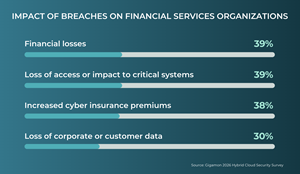
Impact of cyber breaches on financial services organizations
Legal Disclaimer:
EIN Presswire provides this news content "as is" without warranty of any kind. We do not accept any responsibility or liability for the accuracy, content, images, videos, licenses, completeness, legality, or reliability of the information contained in this article. If you have any complaints or copyright issues related to this article, kindly contact the author above.
